Steel Slides, Sprained Ankles, and the Childhood America Decided Was Too Dangerous
Somewhere in a storage box at your parents' house, there might be a photo of you — maybe age seven, maybe eight — perched at the top of a metal slide so tall it required a genuine act of courage to sit down on it. If it was July, that slide was hot enough to brand your legs through your shorts. If it was wet, you were going to the bottom whether you wanted to or not. And if you were lucky, you'd stick the landing. If you weren't, you'd eat gravel and walk home with a story.
That was just Tuesday afternoon at the park.
The Old Playground Was Basically a Controlled Obstacle Course
Playgrounds in the 1950s, 1960s, and well into the 1970s were built around a philosophy that nobody ever officially wrote down but everybody understood: kids are tougher than they look, and a little danger keeps them sharp. Equipment was made from galvanized steel and cast iron. Structures were anchored in concrete — which was also, conveniently, what you landed on if you fell. Jungle gyms rose eight, ten, sometimes twelve feet into the air with no padding beneath them and no safety cage around them. You climbed because you wanted to get to the top, and you understood that getting to the top carried consequences if your grip slipped.
The merry-go-round deserves its own paragraph. If you grew up before roughly 1990, you know exactly what this thing was capable of. A group of kids would get it spinning at a speed that modern engineers would classify as reckless, and then someone would either jump on or get flung off, and either outcome was considered a success. There were no handles designed to slow it down. There was no mechanism to prevent it from reaching dangerous velocity. There was only physics and the collective judgment of eight-year-olds, which, admittedly, was not always sound.
And yet. Kids went to these playgrounds every single day. They got hurt sometimes — genuinely hurt, not just startled. They also got extraordinarily good at assessing risk, negotiating with gravity, and figuring out exactly how far they could push a situation before it pushed back.
How the Lawsuits Changed Everything
The shift didn't happen overnight, but it accelerated sharply through the 1980s and 1990s as personal injury litigation became a more prominent feature of American life. A child's broken arm on school property was no longer simply an unfortunate accident — it was a potential liability. Cities and school districts, facing the prospect of expensive lawsuits, began quietly replacing older equipment with structures that met increasingly stringent safety standards.
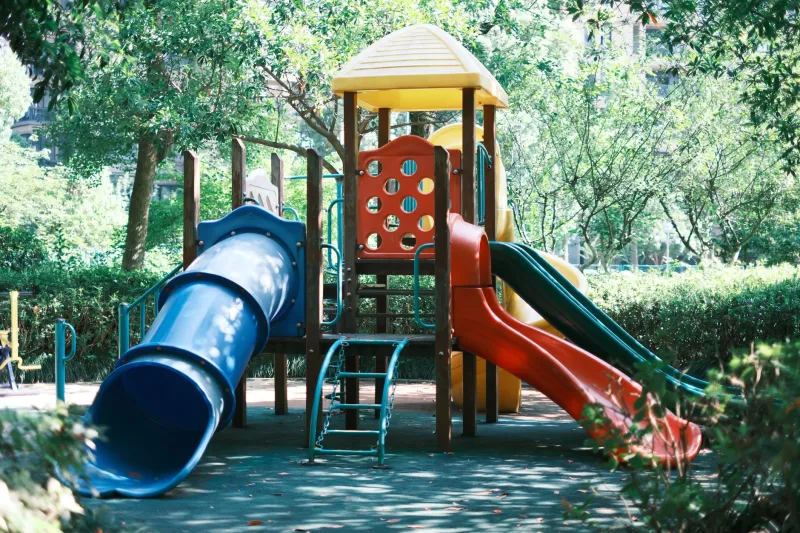
The Consumer Product Safety Commission had been issuing playground guidelines since the mid-1970s, but the real transformation came as those guidelines hardened into something closer to mandates. By the early 2000s, the classic American playground had been almost entirely replaced. Metal gave way to powder-coated plastic. Concrete gave way to rubber mulch and foam tiles. Slides dropped to heights where a toddler could step off the end without incident. Merry-go-rounds largely disappeared from public parks altogether — a casualty of both litigation risk and shifting design philosophy.
The results, measured in emergency room data, are genuinely impressive. Playground injuries dropped significantly. Fatalities became extraordinarily rare. By the cold logic of safety statistics, the modern playground is an unambiguous success story.
But Something Else Happened at the Same Time
Here's where the story gets more complicated. A growing body of developmental research has been quietly suggesting that the drive to eliminate physical risk from childhood play may have introduced a different kind of cost — one that doesn't show up in injury statistics but does show up in anxiety rates, risk-aversion studies, and the capacity of young adults to navigate uncertainty.
Norwegian researcher Ellen Beate Hansen Sandseter, whose work on risky play has influenced playground policy debates across Europe and the US, has argued that children are instinctively drawn to physically challenging play precisely because it serves a developmental function. Climbing high things, moving fast, and testing the boundaries of balance and coordination aren't just fun — they're how children calibrate their understanding of their own physical capabilities and learn to manage fear constructively. When kids regularly encounter manageable risk and survive it, they build what psychologists call self-efficacy: the deep, embodied knowledge that they can handle difficulty.
Take that away entirely, the research suggests, and you don't necessarily get safer children. You may get children who are less equipped to assess real-world risk because they've never had the low-stakes practice.
What Got Better and What Got Lost
This is not an argument that we should bring back twelve-foot metal jungle gyms bolted into bare concrete. Genuine safety improvements matter. Children don't need to be seriously injured to develop resilience, and nobody is nostalgic for the kid who spent a summer in a cast because a poorly maintained swing set gave way.
But there's a meaningful difference between reducing genuine hazards and eliminating all physical challenge. Some cities and school districts have started recognizing that distinction. Adventure playgrounds — a concept borrowed from Scandinavian and British models — have been quietly gaining traction in parts of the US. These spaces often include loose materials, uneven terrain, and structures children can actually modify and climb, operating on the principle that supervised unpredictability is more valuable than sanitized certainty.
The old playground wasn't perfect. But it was honest about something: the world has edges, and learning where they are while you're seven years old, close to the ground and surrounded by friends, is a pretty reasonable time to start finding out.
The rubberized replacement is safer. It just isn't quite the same education.