Three Channels, One Remote, No Complaints: The Unlikely Magic of Having Almost Nothing to Watch
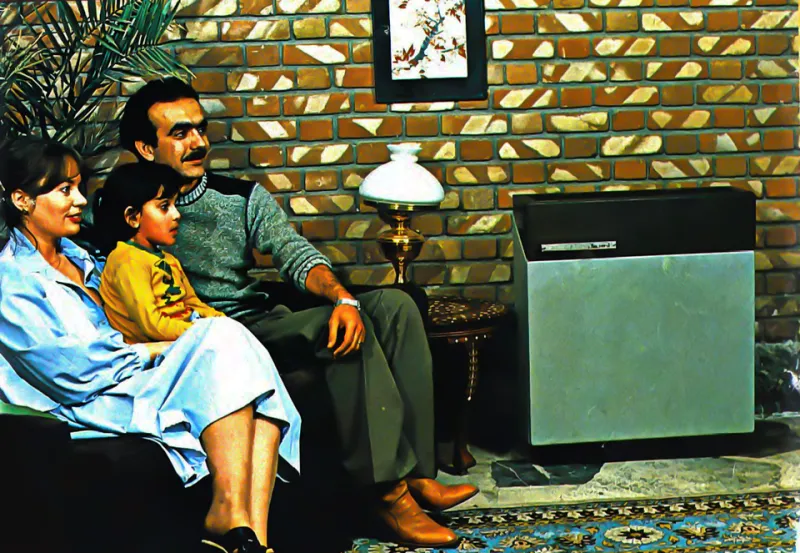
Photo: Farzad Khorasani, CC BY-SA 4.0, via Wikimedia Commons
Somewhere in the mid-1970s, a family of five in suburban Ohio sat down after dinner and turned on the television. They had three network channels — maybe four if the PBS signal came in clean — and whatever was on was what they were watching. The dad wanted the news. The kids wanted cartoons. Mom had been quietly looking forward to a variety show all week. They negotiated. Somebody won, somebody didn't, and they all watched together anyway.
Nobody described that evening as a meaningful shared experience. It was just Tuesday. But from this distance, it looks like something that's genuinely hard to reconstruct.
The Scarcity That Created Community
Television in its early decades operated under a constraint that seems almost incomprehensible now: there wasn't very much of it. Three major broadcast networks — ABC, NBC, CBS — divided the national audience among themselves. Local affiliates filled gaps with reruns and local programming. PBS offered educational content and the occasional British drama. That was largely it.
This scarcity had an unexpected social effect. Because everyone was choosing from the same small menu, Americans watched the same things. The finale of M*A*S*H in 1983 drew 106 million viewers — roughly half the country's population at the time — because there was nowhere else to go. The Super Bowl, the Academy Awards, a presidential address: these events gathered the nation around a common experience not because they were uniquely compelling, but because the alternative was turning off the TV and going to bed.
 Photo: Super Bowl, via ktla.com
Shared viewing created shared reference points. On any given Thursday morning, a significant portion of the country had watched the same show the night before. Water cooler conversation — a phrase that has itself become a relic — assumed this common ground. You didn't have to explain the plot. Everyone already knew.
The Negotiation Was the Point
In households with one television — which was most households until well into the 1980s — choosing what to watch was a democratic process, however imperfect. The remote control, when it finally became standard, became a genuine object of power. Whoever held it held the room.
But even that small domestic drama produced something valuable: people watched things they wouldn't have chosen for themselves. A father who'd planned to watch football found himself drawn into a miniseries his wife had put on. Kids who wanted cartoons got half an hour of the evening news first and absorbed more than anyone realized. The family unit, gathered around a single screen with limited options, was constantly exposed to each other's preferences.
This accidental cross-pollination of taste doesn't happen in a household where every member has their own device and their own algorithmically curated feed. The twelve-year-old watches their content. The parents watch theirs. The viewing experience has been personalized to the point where it no longer requires — or produces — any negotiation at all.
The Abundance That Isolated Everyone
The streaming era arrived promising liberation, and in many ways delivered it. The ability to watch virtually anything, at any time, without commercial interruption, is a genuine improvement on the old model by almost every measurable standard. The content is better. The access is broader. The convenience is extraordinary.
And yet.
The average American household now subscribes to four or more streaming services, with access to libraries containing tens of thousands of hours of content. Netflix alone offers more programming than a person could watch in several lifetimes. The question "what do you want to watch?" has become so loaded that it produces a particular modern paralysis — the twenty-minute scroll through options that ends in either an arbitrary selection or giving up entirely.
More significantly, the abundance has fractured the shared experience that scarcity accidentally created. When a prestige drama releases its entire season at once, some viewers finish it in a weekend while others are still on episode two. Spoiler anxiety replaces communal anticipation. The cultural moment — the thing everyone was talking about because everyone had just watched it together — has become harder to sustain.
And within households, the fragmentation is even more pronounced. Separate streaming profiles. Separate recommendation engines. Separate viewing histories that diverge a little more each week until the family that once gathered around a single screen is now a collection of individuals watching different things in different rooms on different devices.
What Four Channels Accidentally Built
It would be wrong to idealize the old system too aggressively. Broadcast television was also paternalistic, demographically narrow, and occasionally terrible. The scarcity that created shared experience also meant that minority tastes were routinely ignored, that representation was limited, and that viewers had essentially no recourse when the networks got it wrong.
But the accidental community that limited television built — the shared references, the household negotiations, the sense of watching alongside millions of strangers who were seeing exactly what you were seeing — was a real social good, and it was never the point. It was a byproduct of constraint.
Streaming removed the constraint and, with it, the byproduct. The result is more choice and, paradoxically, more loneliness — the specific loneliness of sitting in a room full of people, each looking at their own screen, each traveling somewhere completely different.
The family in suburban Ohio, arguing over three channels on a Tuesday night in 1975, had no idea they were doing something that couldn't be replicated with infinite content and perfect personalization.
They were just watching TV together. That turned out to be the whole thing.