Where Every Man Had His Chair: The Vanishing Kingdom of the American Barbershop
The Sacred Saturday Morning Ritual
Every Saturday morning at 9 AM sharp, Frank would push open the glass door of Sal's Barbershop on Maple Street. The brass bell would announce his arrival, and Sal would look up from his newspaper, already knowing exactly how Frank wanted his hair cut. This wasn't just a haircut appointment — it was a weekly pilgrimage to what sociologists now recognize as America's quintessential "third place," that crucial space between home and work where community actually happened.
For most of the 20th century, the neighborhood barbershop occupied a unique position in American male culture. It was the one place where a factory worker could sit next to a bank president, where teenagers got their first taste of adult conversation, and where the rhythm of small talk created bonds that lasted decades. The barbershop wasn't just about grooming — it was about belonging.
More Than Just a Haircut
Step into a traditional barbershop circa 1960, and you'd find a world operating by unwritten rules that everyone understood. Regular customers had their preferred chairs and their usual barbers. Conversations meandered from the previous night's baseball game to local politics to family updates. The pace was unhurried — a good haircut took time, and rushing was considered almost disrespectful.
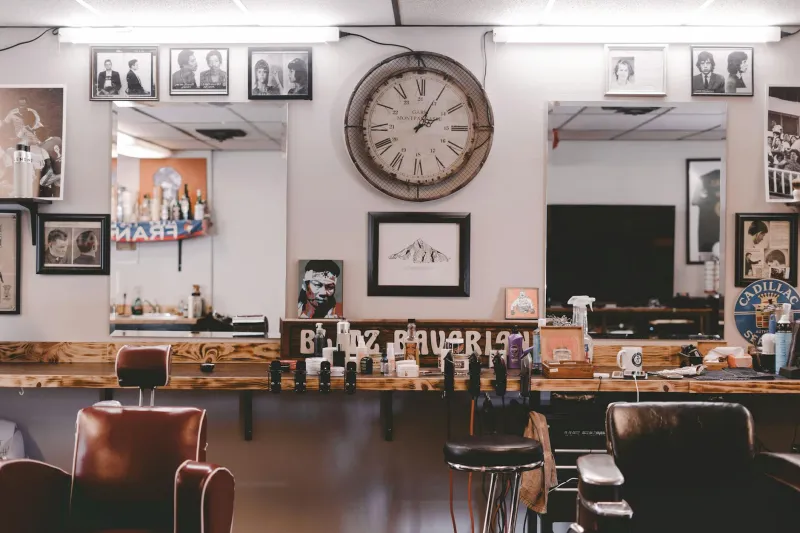
The physical space reinforced this sense of community. Red leather chairs faced a wall of mirrors that allowed everyone to see everyone else. Sports memorabilia and faded photographs covered the walls. Magazines spread across a small table offered reading material, but most men preferred the live entertainment of ongoing conversations. The barber pole outside wasn't just advertising — it was a beacon signaling that this was neutral territory where all were welcome.
Barbers themselves held a special status in their communities. They were confidants, amateur therapists, and keepers of neighborhood news. A good barber remembered not just how you liked your hair cut, but details about your family, your job, and your concerns. They offered advice on everything from marriage troubles to career decisions, and their opinions carried weight precisely because they'd heard it all before.
The Efficiency Revolution
Sometime in the 1980s and 1990s, everything changed. Corporate chains like Great Clips and Supercuts began appearing in strip malls, promising quick, affordable haircuts with no appointment necessary. The business model was brilliantly simple: high volume, low prices, maximum efficiency. What took an hour at the old barbershop could be accomplished in fifteen minutes.
The numbers were compelling. Where Sal might serve eight customers in a morning, a chain salon could process twenty. Where the old barbershop charged $12 for a cut and shave, the new places offered cuts for $8. For busy Americans juggling work and family obligations, the choice seemed obvious.
But efficiency came with costs that weren't immediately apparent. The new salons operated more like assembly lines than gathering places. Stylists were trained to work quickly and move on to the next customer. Small talk was discouraged as inefficient. The chairs faced forward toward mirrors, eliminating the natural conversation patterns of the old shops. Most crucially, there was no expectation of regularity — customers were just as likely to see a different stylist each visit.
What We Lost in Translation
The transformation wasn't just about business models — it reflected deeper changes in how American men socialized. The old barbershop had provided something that modern life struggles to replace: a regular, low-pressure environment for intergenerational male interaction.
In traditional barbershops, twelve-year-old boys sat alongside their grandfathers, absorbing adult conversation and learning unspoken social codes. Young fathers got parenting advice from men who'd raised their own children decades earlier. Retirees found purpose in mentoring younger customers facing career decisions they'd navigated years before.
This informal mentorship system disappeared along with the shops themselves. Today's young men often report feeling isolated, lacking the casual male friendships that previous generations took for granted. The quick-cut model, while efficient, eliminated the time and space necessary for these relationships to develop.
The Appointment-Only World
Modern barbershops that do survive often operate by appointment, fundamentally changing the social dynamic. The old drop-in culture created spontaneous interactions — you never knew who you'd encounter or what conversations you'd overhear. Appointment scheduling, while convenient, eliminates this element of surprise and reduces the chance encounters that built community.
Many contemporary "barbershops" focus heavily on luxury services and premium pricing, targeting affluent customers rather than serving as neighborhood gathering places. While these establishments may recreate some aesthetic elements of traditional shops, they often miss the democratic spirit that made the originals special.
The Search for New Third Places
Social scientists have documented the decline of American "third places" — those informal gathering spots that once anchored community life. Along with barbershops, we've lost many neighborhood taverns, local diners, and corner stores that served similar functions. The result is what sociologist Robert Putnam called "bowling alone" — Americans increasingly isolated from the casual social connections that once defined community life.
Some communities are recognizing what's been lost. A handful of traditional barbershops have survived by emphasizing their role as community gathering places. Others have been revived by entrepreneurs who understand that efficiency isn't everything, and that some customers will pay premium prices for the experience of unhurried conversation and genuine human connection.
The Price of Progress
The death of the neighborhood barbershop represents a classic American trade-off: we gained convenience and efficiency but lost something harder to quantify — the easy camaraderie of regular gathering places. For previous generations of American men, the barbershop provided social infrastructure that we're still learning how to replace.
Today's young fathers often struggle to find spaces for the kind of casual male friendships their grandfathers took for granted. The quick-cut salon serves its purpose, but it can't replicate the sense of belonging that came from having "your" chair in "your" barbershop, where everyone knew your name and your story.
Progress isn't always linear, and efficiency isn't always improvement. Sometimes the old way of doing things served purposes we didn't fully appreciate until they were gone. The barbershop's decline reminds us that some losses can't be measured in dollars saved or minutes gained — only in connections lost and communities quietly dissolved.