The Mahogany Monument to Learning
In the Henderson family's living room, between the piano and the television, stood a shrine to human knowledge: twenty-four burgundy volumes of Encyclopedia Britannica, their gold-embossed spines catching afternoon sunlight like a promise. Mrs. Henderson had saved grocery money for eight months to afford the $400 set—nearly $1,200 in today's dollars. But to her, those books represented something priceless: the entire sum of human understanding, owned outright and available forever.
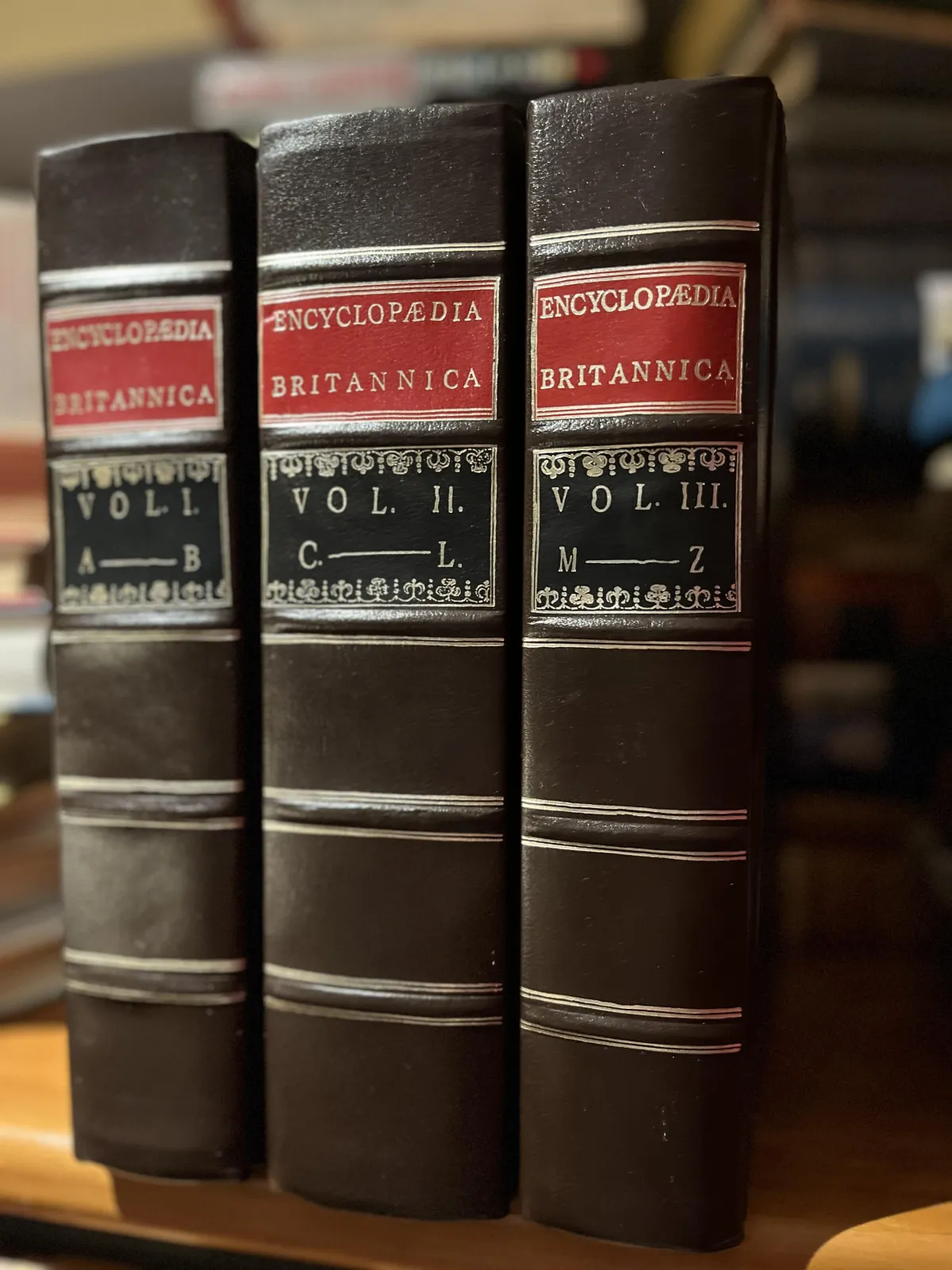 Photo: Encyclopedia Britannica, via pictures.abebooks.com
When ten-year-old Sarah needed to write a report on elephants, she didn't type a query into a search box. She walked to the bookshelf, pulled out the heavy "E" volume, and flipped through actual pages until she found "Elephant, African" and "Elephant, Asian." The information she discovered felt earned, substantial, and permanent.
The Door-to-Door Preachers of Knowledge
Encyclopedia salesmen roamed American suburbs like missionaries, carrying briefcases full of sample pages and payment plans. They understood they weren't just selling books—they were selling parents' dreams for their children's futures. "Your daughter deserves every advantage," they'd say, spreading glossy photographs across kitchen tables. "With Britannica, she'll have the world's finest education right here at home."
The sales pitch worked because it tapped into something profound: the American belief that knowledge was the path to prosperity, and that good parents provided their children with tools for success. Buying an encyclopedia set was an act of faith in education, an investment that might pay dividends for generations.
The Weight of Real Knowledge
Physical encyclopedias demanded respect through their sheer presence. Each volume weighed three to four pounds. The complete set occupied two feet of shelf space and cost as much as a used car. You couldn't casually browse encyclopedia articles while lying in bed—you had to commit to the ritual of research.
This physical weight translated into intellectual weight. Information that required effort to access felt more valuable than information that appeared instantly. When you finally found what you were looking for after flipping through pages and cross-referencing entries, you paid attention differently. You read completely. You remembered more.
The Art of the Deep Dive
Encyclopedia research naturally led to serendipitous learning. Looking up "elephants" meant encountering "Elgar, Edward" on the facing page. Searching for information about the Civil War led you past articles on citizenship, city planning, and circus history. You couldn't help but learn things you weren't looking for.
This accidental education shaped how people understood knowledge itself. Instead of narrow, targeted searches, encyclopedia users developed broader contexts. They understood how topics connected to each other because they literally saw those connections on the page.
The Family Reference Ritual
Dinner table arguments had a different rhythm when encyclopedias ruled. "I'm telling you, the capital of Australia is Sydney," Dad would insist. "Let's look it up," Mom would suggest, and someone would trudge to the bookshelf to settle the matter definitively. The "A" volume would reveal that Canberra, not Sydney, held the honor—and the person who fetched the book would often get distracted reading about Australian wildlife or Aboriginal culture.
These moments of shared discovery built family traditions around learning. Children learned that questions had authoritative answers, that knowledge was worth pursuing, and that being wrong was just the first step toward being right.
The Curator's Careful Hand
Britannica's editors served as gatekeepers of human knowledge, deciding what deserved inclusion and what could be safely ignored. Articles went through multiple rounds of expert review. Contributors included Nobel Prize winners, university presidents, and world-renowned specialists. The encyclopedia's authority came from human curation—real scholars making careful decisions about what mattered.
This editorial process created a coherent worldview. Britannica articles shared consistent style, similar depth, and complementary perspectives. Reading the encyclopedia felt like taking a guided tour through human knowledge, led by experts who understood how all the pieces fit together.
When Updates Came Once a Decade
Encyclopedia knowledge was deliberately static. The 1974 edition remained unchanged until the 1984 revision, creating a stable foundation that families could rely on for years. Children grew up with consistent information, building knowledge layer by layer from the same trusted source.
This stability had unexpected benefits. Because encyclopedia information didn't change daily, people developed deeper relationships with individual articles. They remembered where to find specific information, developing a mental map of human knowledge that served them throughout their lives.
The Google Revolution
Search engines didn't just replace encyclopedias—they transformed how we think about knowledge itself. Instead of owning a curated collection of important information, we gained access to infinite, unfiltered data. Instead of learning broadly through serendipitous browsing, we learned narrowly through targeted searches.
Google's algorithms decide what we see, but unlike Britannica's editors, they optimize for relevance and popularity rather than accuracy and importance. The first search result might be Wikipedia, might be a random blog, might be deliberate misinformation. The burden of evaluation shifted from professional editors to individual users.
The Paradox of Infinite Access
Today's students can access more information in five minutes than previous generations could gather in five hours of encyclopedia research. But studies suggest they retain less, understand context more poorly, and struggle more with information evaluation. The effort that once made knowledge precious also made it memorable.
When information costs nothing to access, it often feels worth nothing to remember. Why memorize the capital of Australia when you can look it up instantly? But this outsourcing of memory to devices may be costing us the deep familiarity with facts that enables real understanding.
The Lost Art of Browsing
Modern search engines excel at finding specific answers but eliminate the happy accidents that made encyclopedia research so educational. YouTube's algorithm might suggest related videos, but they're designed to keep you watching rather than learning. Google's related searches focus on what you're already interested in rather than expanding your horizons.
The random discoveries that once characterized encyclopedia browsing—stumbling across fascinating articles while looking for something else entirely—have largely disappeared from digital research. We find what we're looking for more efficiently, but we discover less along the way.
What We Gained, What We Lost
Digital information access democratized knowledge in ways the Henderson family could never have imagined. Today's students can access primary sources, multiple perspectives, and real-time updates that make 1974 Britannica look quaint. Wikipedia's collaborative model produces articles that are often more comprehensive and current than traditional encyclopedias ever were.
But we lost something too: the sense of knowledge as a precious family possession, carefully chosen and proudly displayed. We lost the ritual of research that made information feel earned rather than given. We lost the serendipitous browsing that connected disparate topics and built broader understanding.
The Shelf That Held the World
Those twenty-four burgundy volumes still sit in some American living rooms, mostly gathering dust. But they represent more than outdated information—they embody a different relationship with knowledge itself. When families owned encyclopedias, they owned learning. When they consulted those heavy volumes, they participated in a ritual that made information feel valuable, authoritative, and permanent.
Today's children will never know the satisfying weight of pulling down volume "E" to settle an argument about elephants. They'll never experience the accidental joy of discovering Edward Elgar while looking up African wildlife. They have access to all human knowledge, instantly and freely. But sometimes, in our rush toward infinite information, we might wonder if we've lost something essential about the simple pleasure of knowing things.