Six O'Clock Sharp: The Dinner Table Ritual That Modern Life Slowly Dismantled
Six O'Clock Sharp: The Dinner Table Ritual That Modern Life Slowly Dismantled
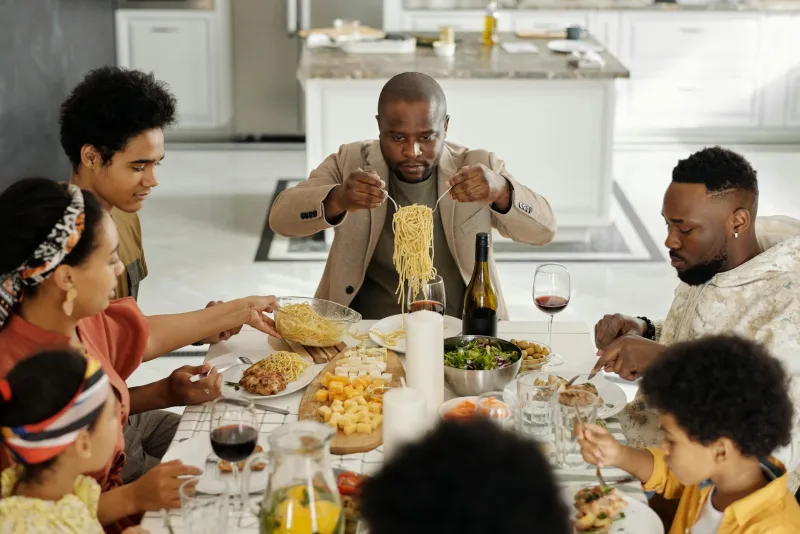
In 1965, if you drove through a residential neighborhood at 6:15 on a Tuesday evening, the streets would have been quiet. Not because nothing was happening — because everyone was inside. At the table. Eating dinner together.
It wasn't a special occasion. Nobody had planned a family moment or scheduled quality time. It was just Tuesday. And Tuesday meant dinner at six, the same as Monday meant dinner at six, and Wednesday, and Thursday. The structure was so embedded in daily life that it barely registered as a choice.
Fifty years later, that same neighborhood at 6:15 on a Tuesday looks completely different. Cars pulling in and out. A teenager eating reheated leftovers alone in the kitchen. Someone else grabbing a drive-through bag on the way back from soccer practice. Dad still at the office. Mom on a conference call. Nobody at a table together, and nobody finding that particularly unusual.
What the Table Used to Mean
The family dinner of the mid-20th century wasn't just about food. It was the primary daily mechanism through which American households stayed connected. It was where kids learned how adults talked, where problems got aired, where the day's events were processed out loud. It was, in a very practical sense, how families actually functioned as units.
Surveys conducted in the 1960s and early 1970s consistently found that the overwhelming majority of American families — estimates range from 70 to 80 percent — ate dinner together at home most evenings of the week. The meal was almost always home-cooked. The timing was almost always predictable. And the expectation that everyone would be present was largely non-negotiable.
This wasn't a middle-class luxury or a suburban ideal. Working-class families, farm families, and urban families across racial and economic lines broadly shared the same pattern. You came home. You ate together. That was the day's anchor.
The Forces That Pulled It Apart
No single thing killed the family dinner. It was dismantled gradually, by forces that each seemed reasonable in isolation but combined to produce a wholesale transformation of domestic life.
Fast food was the first major disruption. McDonald's opened its first franchised location in 1955. By the early 1970s, fast food had become a genuine part of American eating culture — not a weekly treat but an increasingly regular option. The idea that a meal could be purchased cheaply, quickly, and without any preparation began to quietly erode the assumption that dinner meant cooking.
The microwave oven arrived in American homes in significant numbers through the late 1970s and 1980s, and it changed the domestic calculus entirely. Suddenly, individual household members could heat their own food, at their own time, without coordinating with anyone. The shared meal lost one of its practical justifications: the fact that someone had to cook it, and cooking for one made no sense.
Women entering the workforce in larger numbers through the 1970s and 1980s — a genuinely positive development in terms of economic independence and social equality — had an unavoidable domestic side effect. The labor that had sustained the daily family dinner, which had historically fallen almost entirely on women, was no longer reliably available at five in the afternoon. Families adapted, but adaptation often meant simplification, and simplification often meant eating separately.
Longer working hours and longer commutes compressed the evening further. The 1990s and 2000s brought a culture of workplace presenteeism — the expectation that serious professionals stayed late — that made the 6 p.m. family dinner increasingly aspirational rather than standard.
And then came the smartphone. Even in households that managed to get everyone to the table at the same time, the device in the pocket had already begun fragmenting attention in ways that made shared presence feel performative rather than genuine.
What the Numbers Show
The research paints a consistent picture. A 2013 survey by the National Center on Addiction and Substance Abuse at Columbia University found that only about 50 percent of American teenagers reported having family dinners five or more times per week — down significantly from earlier decades. More recent data suggests the number has continued to decline, particularly among households with adolescents and in dual-income families with demanding schedules.
The same research found something striking on the other side of the equation: teenagers who ate dinner with their families regularly were significantly less likely to use drugs or alcohol, less likely to experience depression, and more likely to report feeling close to their parents. The dinner table, it turns out, was doing a lot of invisible work.
The Meaning Behind the Meal
What's interesting about the decline of the family dinner is that it's both a symptom and a cause of broader social changes. It reflects the fragmentation of domestic schedules, the commercialization of food, and the erosion of shared time. But it also accelerates those same trends — because when families stop eating together regularly, they lose the daily practice of simply being in the same room, talking.
The dinner table was never really about the food. It was about the rhythm. About the fact that no matter what else happened during the day, there was a moment when everyone came back together and accounted for themselves.
That moment still exists in some households. But it's no longer the default — it's something you have to consciously choose and actively protect against the current of a culture that has made eating alone, eating fast, and eating while looking at a screen the path of least resistance.
Six o'clock used to mean something. For a lot of American families, it doesn't anymore.