The Sound That Made a Whole Street Come Alive: How America Lost Its Last Community Bell
The Last Pied Piper
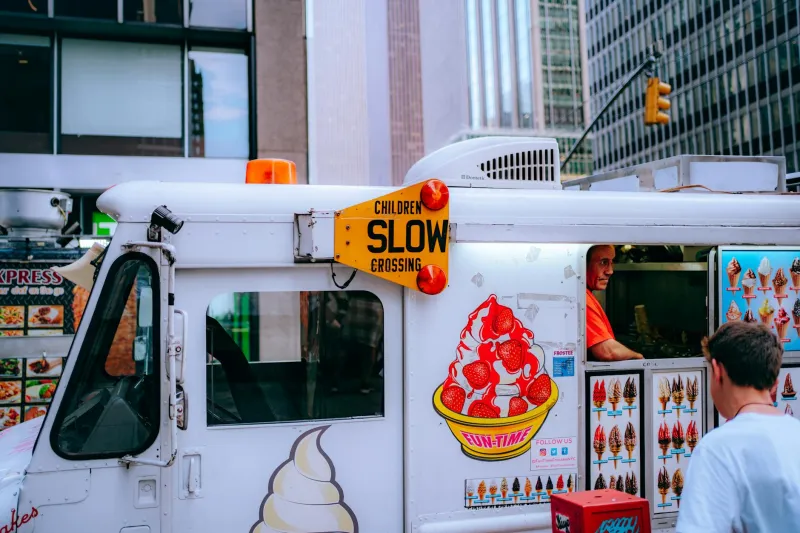
Somewhere between the rise of helicopter parenting and the fall of front porch culture, America lost one of its most democratic institutions: the ice cream truck. Not the vehicle itself—you can still spot the occasional van crawling through suburban streets, playing its warped electronic melody to mostly empty sidewalks. What we lost was the ritual, the community gathering, the unscripted theater that unfolded every summer evening when that familiar tune drifted through screen doors.
In the 1970s and 80s, the ice cream truck wasn't just a vendor on wheels. It was a neighborhood alarm clock, a community coordinator, and sometimes the only reason adults talked to each other all week. The sound of "Turkey in the Straw" or "The Entertainer" crackling through a tinny speaker could empty entire blocks in minutes, turning quiet residential streets into impromptu festivals.
When Everyone Knew the Schedule
Back then, ice cream truck drivers weren't gig workers following GPS routes optimized by algorithms. They were neighborhood fixtures who knew their territory like postal workers knew their routes. Mrs. Henderson's driver came by every Tuesday and Thursday at 4:30 PM. The Kowalski family could count on their truck rolling down Maple Street right after dinner on weekdays, just as the fathers were coming home from work.
These drivers remembered names, preferences, and family dynamics. They knew which kids got allowance on Fridays, which houses always bought the expensive novelty bars, and which parents would emerge with a five-dollar bill to treat the whole crew of neighborhood children. Some kept informal credit systems, trusting regular customers to "pay next time" when kids came running without pocket money.
The trucks themselves were local operations, often family businesses passed down through generations. Routes were inherited like family farms, and drivers took pride in maintaining relationships with their customers. They'd stock extra rocket pops when they knew the Little League team was celebrating, or remember to bring sugar-free options for the diabetic grandfather on Elm Street.
The Democracy of Frozen Treats
What made the ice cream truck special wasn't the product—it was the process. Unlike today's world of predetermined choices and predictable outcomes, the truck represented pure possibility. You never knew exactly what would be available, which flavors might be sold out, or whether they'd have that special item you'd been hoping for.
More importantly, it was one of the few remaining spaces where economic differences temporarily dissolved. The investment banker's kids stood in line behind the factory worker's children, all clutching the same crumpled dollar bills, all equally excited about the same simple pleasure. Rich neighborhoods and working-class blocks got the same selection, the same prices, the same cheerful service from drivers who treated every customer like a regular.
The ice cream truck was also beautifully inefficient. There was no pre-ordering, no scheduled delivery windows, no customer reviews or loyalty programs. You heard the music, you dropped whatever you were doing, you found some change, and you ran outside. If you missed it, you missed it. This unpredictability created a sense of urgency and excitement that no amount of convenience can replicate.
The Great Retreat Indoors
Several forces conspired to kill this ritual. The first was air conditioning becoming standard in American homes. By the 1990s, families were spending summer evenings inside climate-controlled environments rather than on front porches or in yards where they could hear approaching trucks. The soundtrack of summer shifted from ice cream melodies and neighborhood chatter to the hum of central air and the glow of television screens.
Simultaneously, American parenting culture underwent a seismic shift. The generation that had grown up chasing ice cream trucks became parents who scheduled every moment of their children's lives. Spontaneous treats gave way to planned snacks. Unstructured play time became extinct. The idea of children running freely through neighborhoods—even their own neighborhoods—began to feel dangerous rather than normal.
Supermarkets also evolved into frozen dessert wonderlands. Why wait for a truck when you could stock your freezer with every possible ice cream variety? Why pay truck prices when you could buy in bulk? The convenience of having treats available 24/7 made the scheduled uncertainty of ice cream trucks seem almost primitive.
The New Efficiency
Today's frozen treat landscape is optimized for individual convenience rather than community gathering. Apps like Uber Eats and DoorDash can deliver premium ice cream to your door in thirty minutes. Grocery stores stock hundreds of frozen options. Home ice cream makers let families create custom flavors on demand.
This system is objectively better in almost every measurable way. It's more convenient, offers more variety, costs less per serving, and accommodates dietary restrictions and personal preferences with unprecedented precision. You can get exactly what you want, when you want it, without leaving your house or coordinating with anyone else.
But something essential was lost in this optimization: the element of surprise, the forced interaction with neighbors, the shared anticipation, and the simple democracy of standing in line together for something special.
What We Really Lost
The death of the ice cream truck ritual represents more than the decline of a particular business model. It marks the end of one of America's last truly spontaneous community experiences. In an era where every interaction is mediated by technology and every social gathering requires advance planning, the ice cream truck offered something increasingly rare: unscripted togetherness.
Those few minutes of neighborhood chaos—parents chatting while kids debated flavor choices, teenagers showing off for each other, grandparents remembering their own childhood treats—created the kind of casual social fabric that modern life systematically eliminates. We didn't lose just the ice cream truck. We lost the last excuse to stop what we were doing and share a moment with the people who lived around us.
The trucks are still out there, playing their lonely songs to increasingly empty streets. But the community that once came running has retreated behind closed doors, content with the efficiency of individual satisfaction over the messy beauty of shared joy.