The Compounding Counter: How American Pharmacy Lost Its Personal Touch
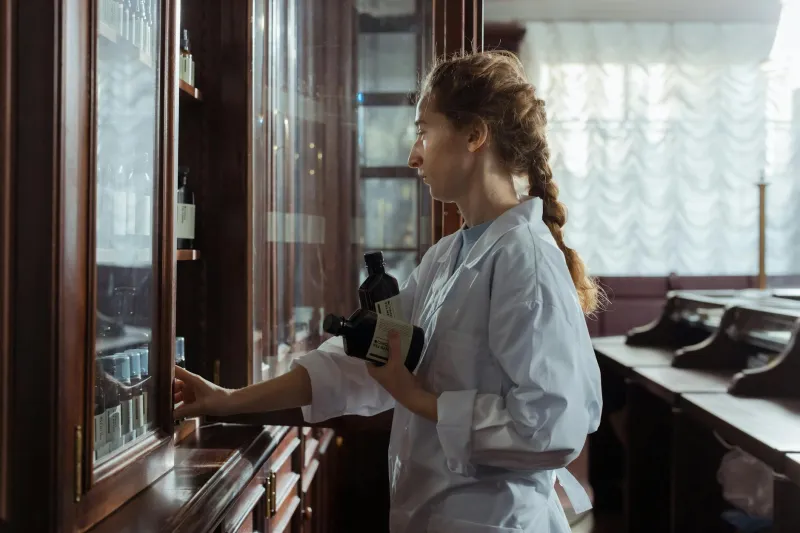
The Compounding Counter: How American Pharmacy Lost Its Personal Touch
Walk into a modern pharmacy and you'll likely see a drive-through window, a line of people clutching printed receipts, and automated machines clicking and whirring behind a barrier. The pharmacist—if you catch a glimpse—is usually behind plexiglass, processing dozens of prescriptions with the efficiency of an assembly line. It's fast. It's convenient. It's also profoundly different from what American pharmacies looked like just fifty years ago.
When Your Pharmacist Knew Your Medical Story
In the 1950s and 1960s, the corner drugstore was a destination. Not just because you needed medicine, but because the pharmacist there was someone your family trusted. He knew your mother's arthritis. He understood that your father's blood pressure medication sometimes made him dizzy. He could tell you which cough syrup worked best for your particular type of cold—not because a computer told him, but because he'd been filling prescriptions for your household for a decade.
These pharmacists were compounders. They didn't simply count out pills from pre-filled bottles. They mixed medications by hand, measured powders on brass scales, and combined ingredients in glass mortars with pestle. A child's dose of penicillin wasn't a standardized tablet—it was a custom liquid suspension, sweetened with cherry flavoring because the pharmacist knew kids wouldn't take it otherwise. A patient with a specific allergy might receive a medication formulated without the problematic ingredient. Customization wasn't a premium service; it was the baseline.
The pharmacist's role extended beyond the counter. He was an informal health advisor, someone you could ask about a rash or a persistent headache. He knew which over-the-counter remedies actually worked and which were snake oil. He caught potential drug interactions before they became dangerous. He was, in many ways, a gatekeeper of health knowledge in an era when most people didn't have regular access to a physician.
The Supermarket Revolution Changed Everything
The transformation began in the 1970s and accelerated through the 1980s and 1990s. Supermarkets added pharmacy departments. Chain drugstores expanded aggressively. Pharmaceutical manufacturers began pre-packaging medications in standardized doses. The logic was sound: mass production reduced costs. Consistency improved safety. Scale made healthcare more accessible to more people.
But something fundamental shifted. The pharmacist transitioned from craftsperson to technician. The relationship between pharmacist and customer became transactional. You dropped off a prescription. You came back three hours later. You paid and left. The pharmacist's name was usually on a plastic nameplate you'd never notice.
Automation accelerated the change. By the 2000s, robotic dispensing systems were filling prescriptions with mechanical precision. A machine could count out pills faster and with fewer errors than any human. Barcode scanners verified every step. The need for the pharmacist's judgment and expertise seemed to diminish with each new technology.
What Efficiency Actually Replaced
Modern pharmacy is undeniably more convenient in some ways. You can get a prescription filled in minutes. You can use an app to refill medications without speaking to anyone. Many insurance plans now cover mail delivery of regular prescriptions. The price of medications has become more transparent—at least compared to the mystery pricing of decades past.
Yet the trade-offs are worth examining. Today's pharmacy technicians—underpaid, overworked, and often operating under intense corporate pressure—handle the actual dispensing while pharmacists spend much of their time on insurance authorization and corporate metrics. The relationship that once existed between pharmacist and patient has largely evaporated. If you have a question about a medication's side effects, you're likely to get a canned response or a referral to call your doctor.
Compounding—the very skill that defined pharmacy for centuries—has become a specialty service, often available only at independent pharmacies or through mail-order compounding centers. The vast majority of Americans have never had a medication compounded specifically for them. Many don't even know it's possible.
The Quiet Loss of Trust
There's a deeper issue lurking beneath the convenience. Healthcare, by its nature, requires trust. When you take a medication, you're placing faith in someone's expertise and judgment. For generations, that someone had a face, a name, and a history with you and your family. They had skin in the game—their reputation depended on their competence and care.
Today's pharmacy system is built on different principles: standardization, efficiency, and liability management. These aren't bad things. They've made medication safer in measurable ways. But they've also created distance. When something goes wrong with a medication, it's harder to know who to blame or where the breakdown occurred. Was it the manufacturer? The insurance company? The pharmacy? The prescribing physician? The system is so fragmented that accountability becomes diffuse.
Some independent pharmacists have tried to reclaim the old model, emphasizing personal relationships and medication consultation. A few pharmacies have brought back compounding services. But these are niche offerings, available mainly to wealthier patients willing to pay out of pocket. For most Americans, pharmacy is something that happens to you, not something you participate in.
The Then and Now
The pharmacist who mixed your medicine by hand is largely extinct in America. In his place is a system optimized for volume and cost control. We've gained speed and scale. We've lost the relationship. Whether that's a fair trade depends on what you value—and whether you ever experienced the alternative.